
How to Check for a Warrant in Stonewall
Stonewall posts contacts but no docket. A warrant check here is a phone conversation, not a search box, and the person to have it with is the clerk the Stonewall site names.
- Call Stonewall at 601-659-7033 and ask for the court clerk.
- Give the citation number and the appearance date, and ask whether the file is municipal.
- Ask whether the docket shows a failure to appear, bench process, a capias, or a balance.
- If the Stonewall clerk says it is a county matter, call Justice Court at 601-776-5371 instead.
- Use the Stonewall mailing or fax route for a written request once the clerk confirms the procedure.
Stonewall's 2020 Census Count
Size shapes access in Stonewall. The Census Bureau's 2020 incorporated place table ranks Stonewall second among the county's five towns.
A Stonewall office this small answers everything itself. That helps once you reach someone and hurts when hours run short.
The Stonewall Police Department and Municipal Court
Stonewall maintains a current officials page, and it is the best first reference for who sits in each seat. It lists Pamela Tew as court clerk and Don Moore as police chief.
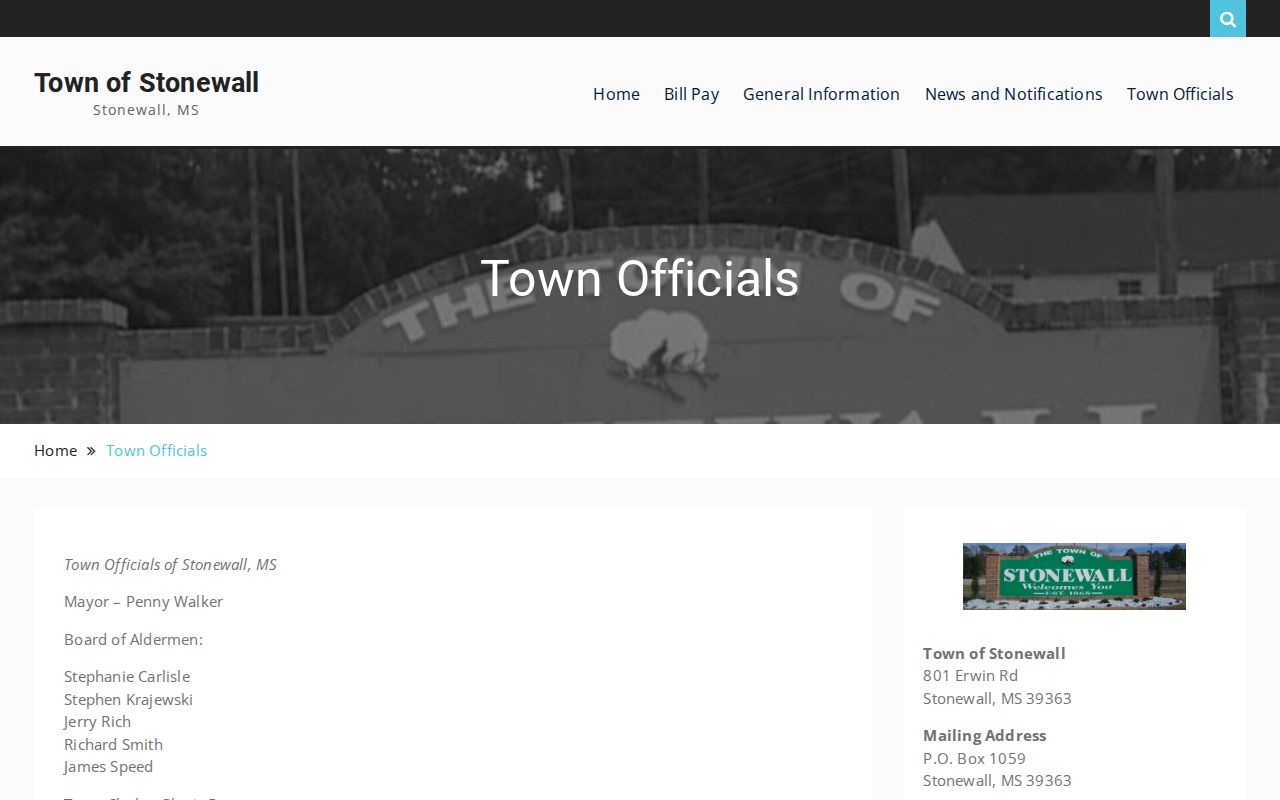
Treat that page as a directory of roles. It offers no warrant unit, no warrant email, no public list, and no station address with counter hours. The county sheriff keeps no Stonewall docket either.
Two Official Stonewall Sources Disagree
Both Stonewall records trails are official, yet they disagree. The current town website names one set of officials. The state municipal government directory, on its own publishing cycle, lists a municipal judge and other names along with the mailing box, the fax at 601-659-7035, and the town email.
Caution: Do not merge the two lists into one roster, because a dated directory entry can name someone who has since left the office.
Use the Stonewall page for current officeholders and the directory for a fax or mailing fallback. Confirm by phone, and note the date you did.
Types of Stonewall Warrants
A Stonewall judge's authority runs to Stonewall business. Anything outside that lane belongs to another court.
| Warrant Type | How It Arises | Who Issues It |
|---|---|---|
| Town traffic warrant | An unpaid Stonewall citation or a missed town traffic setting | Stonewall municipal judge |
| Ordinance warrant | A town code matter charged by the city and left unresolved | Stonewall municipal judge |
| Town bench warrant | A missed session on an existing municipal case | Stonewall municipal judge |
| County or circuit process | A highway patrol, sheriff, or indicted matter | Justice Court or Circuit Court judge |
Stonewall Court Before the County Sheriff
People holding a Stonewall citation often phone the county first, reasoning that the sheriff handles everything. The sheriff covers the county, which is not the same thing. A Stonewall file sits outside the sheriff's records, appears on no county docket, and cannot be closed by a county office. Call 601-776-5252 only to ask which agency holds a given record or how to send a written request. For a court date, a balance, or an order, the town clerk is the office with the answer.
What a Stonewall Warrant Record Shows
The list that follows describes what a Stonewall warrant file holds. Ask the clerk to read each item aloud.
| Citation Number | The number on the town ticket, in a format such as SW-2024-0133. |
|---|---|
| Charge | Town traffic or a Stonewall ordinance matter. |
| Issuing Court | Stonewall Municipal Court, separate from the county Justice Court. |
| Original Setting | The date that was missed, and whether the court has set another. |
| Process Label | Bench warrant, capias, or failure to appear, in the clerk's own wording. |
| Next Action | Payment, appearance, reset, bond, or a judge's order. |
A Stonewall Citation With No Trace
A search turns up nothing, and the Stonewall temptation is to assume the case vanished. Several ordinary explanations fit better. Each one points to a different office.
- The file is municipal and never appeared online, because Stonewall publishes no docket
- The citation was county issued, so it sits with Justice Court rather than the town
- The matter moved to the circuit docket after a bind over or an indictment
- The paper file predates whatever Stonewall keeps at hand
- The record is restricted, which is an access boundary rather than an answer
Note: work through those possibilities with the clerk on one call rather than trusting the quietest explanation.
Where Stonewall Warrants Fit With Clarke County
A Stonewall order stays a Stonewall order. Any officer with authority may serve it, but it never becomes a county case unless a court transfers it.
Warrant flow: Stonewall Municipal Court › Clarke County Sheriff for service › state law enforcement systems, which have no public search
The Clarke County warrant records overview carries the county statutes, the circuit route, and the sheriff's records process for anyone who needs those.
Mail, Fax, and Email in Stonewall
When the Stonewall phone goes unanswered, the state directory supplies three written routes: a mailing box at P.O. Box 1059 in the 39363-1059 zone, a fax at 601-659-7035, and a town hall email address. Use them for something specific. Name the citation number, the date, and the exact record you want, then ask about the fee and how it will be delivered. A fax proves you sent a request, not that anyone received it, so follow up by phone.
Public Access to Stonewall Warrant Records
The state law that opens a county file opens a Stonewall one too, under the same limits. Stonewall sets its own request procedure. The town publishes no form or fee schedule.
Key Rules:
Mississippi Public Records Act of 1983 - Town court records are open unless a statute provides otherwise.
Miss. Code § 25-61-12 - Investigative material may be withheld while an incident report is released with protected parts removed.
Miss. Code § 43-21-255 - Juvenile law enforcement records are confidential and go to the court, not a records request.
Stonewall Dockets and Seven-Year Files
The state municipal retention schedule published in January 2024 spells out what Stonewall keeps. Court dockets and minutes are permanent. A case file with an affidavit, an arrest warrant, a bond, or a payment is kept seven years past disposition, and a traffic file three years. Retention says nothing about digitization or current status. It only means a Stonewall clerk may still locate the folder, which is often exactly what someone needs.