
Municipal Court Warrants in Clarke County
A Clarke County municipal court handles town-level matters. That means its own ordinances, its own traffic citations, and the misdemeanor cases that fall inside its authority. Miss a setting, and the judge who set it can issue a warrant. That warrant stays in the town's file. It does not migrate to the county. The county courts page names the Justice Court and the Circuit Court but speaks for no town docket, and no shared municipal index exists anywhere in Clarke County. A warrant question goes back to the issuing town.
Five Clarke County Municipal Dockets
Clarke County has five incorporated places. Each one runs its own separate court lane, and the population figures come from the Census Bureau's 2020 incorporated place table.
Scale shapes access in Clarke County. The larger towns publish court pages with named staff, while the smallest show up mainly through a state directory entry and a phone number.
Which Cities Have Municipal Courts
All five Clarke County towns do. What differs is how much each one publishes. That is why the contacts below mix direct court lines with general town numbers drawn from the official state municipal directory.
| Town | Court | Typical Warrant Types | Published Contact |
|---|---|---|---|
| Quitman | Quitman Municipal Court | City ordinance, city traffic, failure to appear | Court clerk 601-776-6461 |
| Stonewall | Stonewall Municipal Court | City ordinance, city traffic, failure to appear | Town hall 601-659-7033 |
| Enterprise | Enterprise Municipal Court | City ordinance, city traffic, failure to appear | Town Hall, 500 River Road |
| Shubuta | Shubuta Municipal Court | City ordinance, city traffic, failure to appear | Municipal clerk 601-687-1536 |
| Pachuta | Pachuta municipal lane | City ordinance, city traffic, failure to appear | Village clerk 601-776-3131 |
Note: the Pachuta directory entry lists no municipal judge, so ask the village clerk in Clarke County who presides before assuming a session exists.
A Clarke County Town Court Portal
Enterprise stands out in Clarke County. It is the only town here with a linked online court presence. The official town general information page places the police department and the clerk's office inside Town Hall at 500 River Road, and it says municipal court meets the first Wednesday of each month at 1:30 in the auditorium. The town links a government portal from there. The portal carries an Enterprise Municipal Court tile and a Pay Here button. Payments happen there. It does not answer warrant questions, and that limit is the part worth knowing.
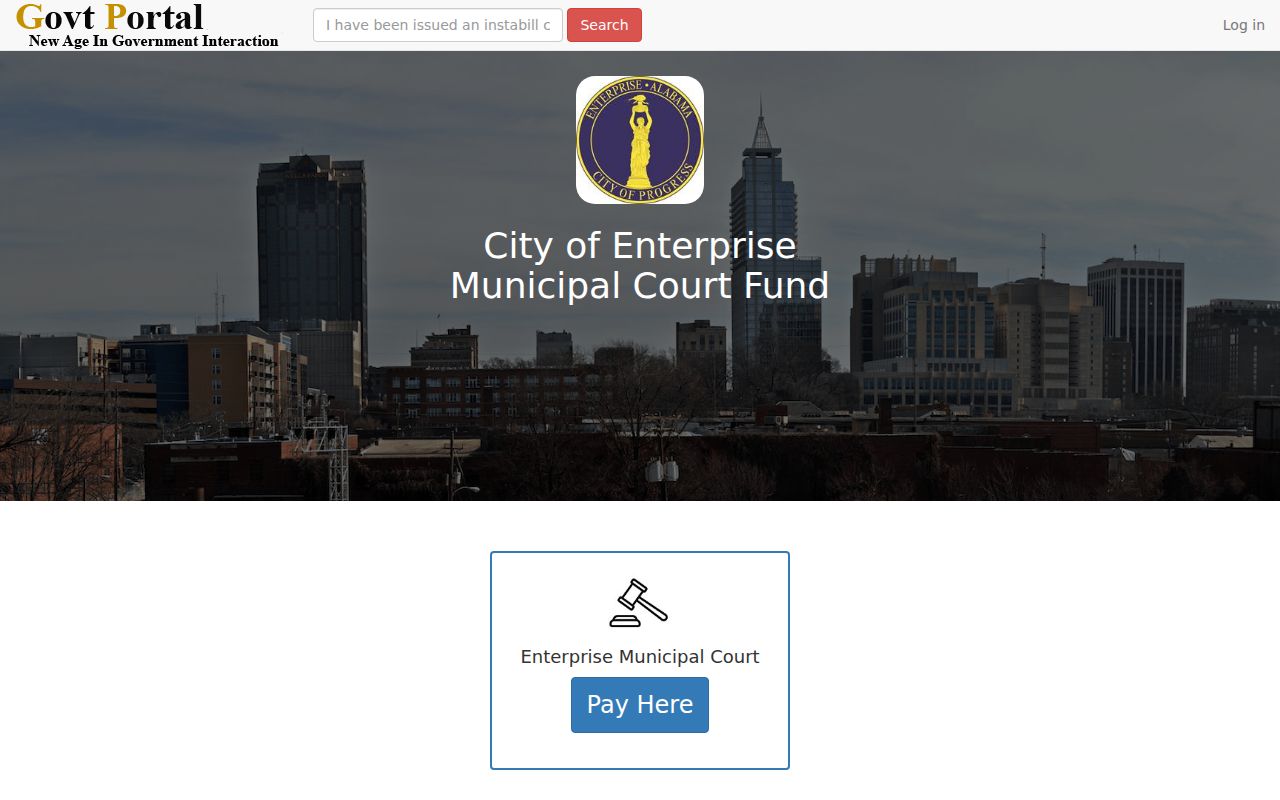
The portal's City, Phone, and Email fields sit blank. No case search lives on it. There is no name field or status result either, so treat it as a Clarke County payment tool once the clerk confirms what you owe.
How to Check a Municipal Court Warrant
Clarke County gives you few channels. The routine is therefore short, and each step below comes from an official town or county source.
- Call the clerk in the town named on the citation and give the citation number and appearance date.
- Ask whether the docket shows a failure to appear, bench process, a capias, or an outstanding balance.
- Ask when the next session is held and whether the judge must review anything before then.
- If the clerk says the file is not municipal, call Clarke County Justice Court at 601-776-5371 instead.
- For a copy of a record, ask the town for its own request procedure and fee rather than sending a state form.
City Warrants Outside the Clarke County Map
The costly assumption is that Clarke County would know. It would not. The sheriff publishes no list, the Clarke County Justice Court docket covers county and highway patrol matters rather than town ones, and the circuit electronic system covers circuit filings. A town warrant can slip past all three.
Key point: Silence from the county tells you nothing about a town court file, so ask the town that issued the citation before concluding anything.
What a Municipal Court Warrant Shows
No Clarke County town posts a live record. The fields below reflect what a municipal file holds under state retention categories and court process rules. Use them as your question list for the clerk.
| Town and Court | The municipality whose judge signed the process. |
|---|---|
| Citation Number | The number on the ticket, in a format such as MC-2024-0417. |
| Charge | City ordinance, city traffic, or a misdemeanor within the court's authority. |
| Original Setting | The court date that was missed, which is what usually starts the process. |
| Process Label | Bench warrant, capias, or failure to appear, in the clerk's own wording. |
| Balance and Payment | What is owed, and whether the court has accepted anything toward it. |
| Next Action | Payment, appearance, reset, bond, or a judge's order. |
When Clarke County Court Listings Disagree
Stonewall shows the Clarke County problem in miniature. Its current town officials page names a court clerk and a police chief. The state directory lists other names. Published on a different cycle, it adds a mailing box, a fax line, and a town email. Both are official Clarke County sources. Neither is automatically wrong. Treat the town's own current page as the personnel reference, and treat the state directory as a dated fallback for mail and fax. Then confirm by phone, ask the person who answers to state their role, and note the date you called.
Resolving a Municipal Court Warrant
Start with the clerk. Ask the Clarke County court what it requires, in what order, and whether the clerk can accept a payment. Some matters end there. Others need a reset, a bond, the next session, or a judge's signature on an order. Nothing is posted in advance. No Clarke County town publishes a recall form, a bond schedule, or a fee table you could read ahead of time.
Caution: Get written proof of any payment or reset, and ask specifically whether the court still treats the process as open after you pay.
Clarke County Town Court Roles
Four offices touch a Clarke County town warrant. They are easy to mix up on the phone, and knowing which one you reached saves a second call.
- Municipal judge
- Signs the process and is the only person who can change it.
- Municipal clerk
- Keeps the docket, takes payments where allowed, and explains the court's procedure.
- Town police
- Writes city citations and may serve process. Does not run a public warrant list.
- County sheriff
- A separate agency entirely, useful for records custody questions and nothing about a town docket.
Note: a clerk in Clarke County can describe what the court does but cannot give legal advice about your case.